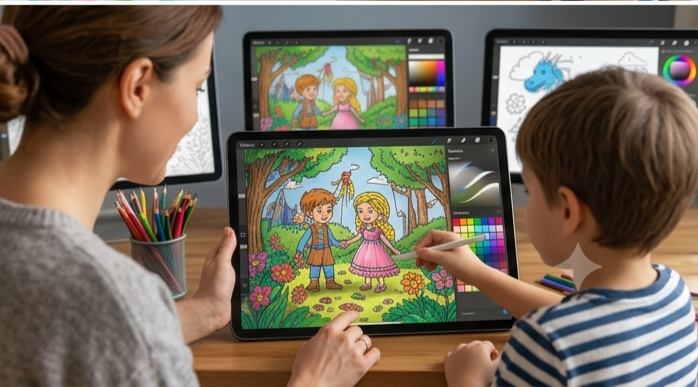
Shy and timid children often fear talking about themselves because they perceive direct attention as pressure. The fairy tales on the BubuTales website become a perfect "bridge": the child talks not about their fears, but about the adventures of the hero, which is psychologically much easier.
Here are step-by-step tips for parents on how to get a toddler to open up through fairy tale characters (all the fairy tales, based on cartoons listed below, can be found on our website):
1. Use the “Third Person” Method
Instead of directly asking, “Why were you afraid at kindergarten?”, ask about the hero.
• Tip: After reading the story about Racer, ask: “How do you think Racer felt a little nervous when he got a new task? What helped him calm down?”
• Why it works: The child projects their state onto the hero. By telling about the hero, they are actually talking about themselves.
2. Game “What’s in the Hero’s Pocket?”
Shy children find it easier to talk about objects than about feelings.
• Tip: Ask: “If Moana were going on a trip and could only take one thing to not miss home, what would it be?”
• Development: This will help you find out what is most valuable to your child (a toy, photo, talisman).
3. The “Magic Mirror” Technique
Invite the child to imagine that a hero from BubuTales is looking at them through the screen.
• Tip: “Imagine Simba is looking at you right now. Which one of your traits would he call truly royal/brave?”
• Effect: This stimulates the child to look for positive qualities in themselves and to voice them, boosting self-esteem.
4. Create Alternative Endings
This gives the child a sense of control, which shy people often lack.
• Tip: “What if Rapunzel didn’t have long hair, how else could she get out of the tower? Let’s come up with a clever plan together.”
• Effect: Joint imagination relaxes the child and removes speech blocks.
5. The “Advice to the Hero” Method
Make the child an expert. Shy children blossom when their opinion matters.
• Tip: “Lightning McQueen was very upset because he lost. What would you say to him so he wouldn’t cry?”
• Why it works: When the child comforts the hero, they themselves learn self-soothing patterns.
Here are 5 more effective play techniques that will help a shy child open up using characters from BubuTales fairy tales:
1. Game “Interview with the Hero”
Imagine you are a journalist, and the child is a favorite character (for example, Marshall from “Paw Patrol” or Elsa).
• How to do it: Take a toy microphone (or just a comb) and ask: “Mr. Marshall, today you saved a kitten! Tell us what you were thinking at that moment.”
• Why it works: It is easier for the child to answer on behalf of the hero. This removes personal responsibility: “it’s not me speaking, it’s the character.”
2. The “Secret Message” Technique
Invite the child to send a “secret” to the hero that will help them in the story.
• How to do it: “Look, Rapunzel is afraid to leave the tower. Let’s whisper to her (to the screen) what secret of bravery you know? Maybe you just need to close your eyes and count to three?”
• Why it works: It encourages the child to voice their own strategies for overcoming fear, which they previously kept silent about.
3. The “Magic Mail” Method
If the child finds it hard to speak out loud, start with “correspondence.”
• How to do it: Write a note from Olaf’s perspective: “Hi! I love summer but I’m afraid of melting. What are you afraid of?” Place it under the pillow or near the tablet where you read BubuTales. Invite the child to draw or dictate a reply.
• Why it works: Gradually, “written” or visual communication transitions into verbal (spoken) communication.
4. Game “Emotion Detective”
Use illustrations on the website to guess the mood of a character.
• How to do it: Point to a hero (for example, Simba who looks sad) and ask: “Oh, look at his tail and ears. What do you think he is feeling now? Is he lonely or just tired?”
• Why it works: This develops emotional intelligence. The child learns to recognize emotions in others, which later helps them name their own feelings.
5. The “Adult’s Mistake” Trick
Deliberately mix up facts in the fairy tale you just read on the site.
• How to do it: Say: “Oh, what an interesting story about how Lightning McQueen flew into space on a rocket!”
• Why it works: Even the shyest child will want to correct the adult: “No, he didn’t fly, he took part in races!” This provokes spontaneous speech and removes the fear of making mistakes.
Little lifehack: If the child absolutely doesn’t want to talk, start a dialogue on behalf of a toy or a picture on the site: “Hi! I’m Olaf, I really love hugs, but today I’m a little sad. Will you tell me something interesting?”